
 Tiếng Việt

When Does Apartment Wood Flooring Need Replacing?
You should replace the flooring when damage has spread or is affecting daily life. Common warning signs include:
- Boards bulge or warp after water exposure or high humidity.
- Wide gaps appear between boards, and the joints no longer sit tight.
- The floor creaks when walked on, or boards pop out of their locking joints.
- The surface is scratched, faded, or the top coating is peeling over a large area.
- The old flooring has reached the end of its lifespan, or you simply want a different type or color.
If only a few boards are damaged and matching spare boards are available, a partial replacement can save money. When damage is widespread or warping is extensive, a full replacement gives a more even color and longer-lasting result. Catching the problem early and acting on it also prevents moisture from spreading into the subfloor, which becomes far more costly to fix later.

Replace a Few Boards or the Whole Floor?
Whether to replace individual boards or the entire floor depends on how much damage there is and whether matching replacement boards are available. The two options have different trade-offs:
- Partial replacement: cheaper and faster, suitable when only a few boards are damaged and matching spare boards are on hand. The downside is that new boards may not perfectly match the color of flooring that’s been in place for years.
- Full replacement: gives even color and consistent durability, and lets you switch to a different flooring type or color. It costs more but is worthwhile once the floor has deteriorated significantly.
With click-lock flooring, replacing a board in the middle of a room sometimes means removing several adjacent boards in sequence — so if the damaged spot is deep inside the room, a full replacement can actually be less labor overall.
Should You Install New Flooring Over the Old Floor?
In most cases, laying new flooring directly over the old floor is not recommended. It raises the floor height, which can catch on door frames, and the new floor inherits any bulging or warping already present in the layer underneath.
The more durable approach is to remove the old flooring, prepare and level the subfloor, then install the new flooring. This way, the underlayment and expansion gaps are installed correctly, and the new floor stays stable instead of repeating the same problems.
Laying over the old floor should only be considered when the existing floor is still flat, dry, and there’s enough clearance under doors — but this is an exception, not the standard approach for apartments.
Do You Need to Notify Building Management for Floor Replacement?
Replacing flooring inside an apartment usually doesn’t require formal permission if it doesn’t affect the building’s structure, but you almost always need to register the work schedule with building management. Removal and board cutting generate noise, so most buildings control this closely.
Most apartment buildings set specific hours when noisy work is allowed, along with elevator time slots for moving materials and debris. Registering in advance helps you avoid warnings or having the work stopped midway.
Moving the old flooring out and bringing new materials in also needs to follow the building’s rules. A team experienced with apartment work will already know these regulations and handle the logistics smoothly.

Which Flooring Type Should You Choose?
Choosing the right flooring type when replacing determines long-term durability and cost. Three common options for apartments:
| Flooring type | Advantages | Best for |
|---|---|---|
| Laminate flooring (green-core HDF) | Reasonable price, fast installation, decent moisture resistance | Most living rooms and bedrooms |
| SPC / wood-look vinyl flooring | Strong water resistance, dimensionally stable | Kitchens, balcony-adjacent areas, humid zones |
| Solid wood flooring | Upscale, warm, ages well over time | Premium spaces where aesthetics matter |
For apartments, moisture-resistant green-core laminate flooring is usually the best balance of price and durability. Areas with frequent moisture exposure should prioritize water-resistant flooring to prevent bulging.
If water resistance is a priority for your kitchen or a humid area, see glue-down wood-look vinyl flooring installation in HCMC.
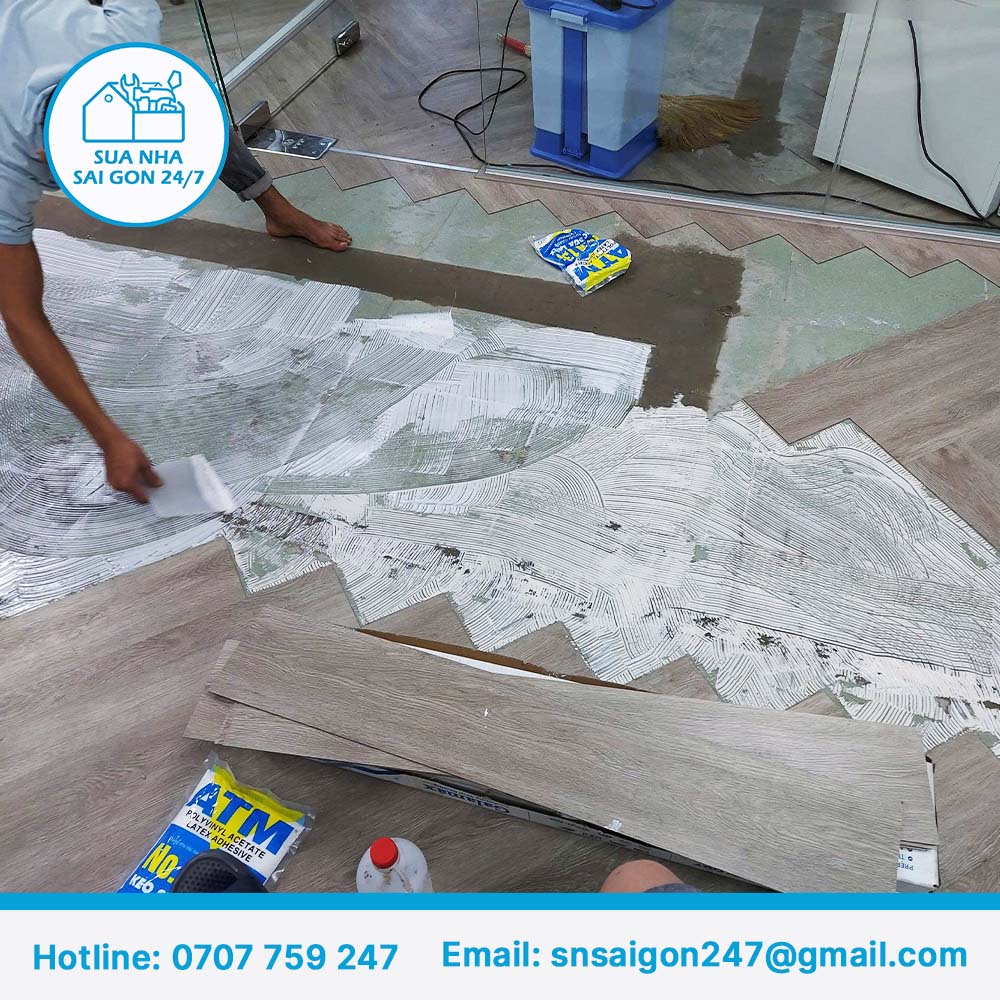
Apartment Wood Floor Replacement Process
The quality of a new floor depends largely on subfloor preparation, not just the installation step itself. The standard process has 6 steps:
- Survey & preparation: measure the area, check subfloor flatness and moisture level, move furniture, and register the schedule with building management.
- Removing the old flooring: take off baseboards, remove the old floor, collect and haul away the debris.
- Subfloor preparation: clean and check flatness; grind or re-level uneven spots; apply moisture treatment if needed.
- Laying the underlayment: install foam/padding and a moisture barrier to standard, reducing noise and protecting the floor.
- Installing the new flooring: lay boards in the direction of natural light, leave expansion gaps around the walls, lock joints firmly, and stagger the seams.
- Finishing & handover: reinstall baseboards, trim door bottoms if they catch, clean up, and check flatness together with you.
Skipping subfloor preparation or expansion gaps is the most common reason new flooring warps, develops gaps, or starts creaking after only a short time.
Apartment Wood Floor Replacement Pricing 2026
Replacement cost includes removing the old floor, new flooring materials, and installation labor. Below is a general market reference range:
| Service item | Reference price (VND/m²) |
|---|---|
| Removing old wood flooring | 10,000 – 15,000 |
| Installation labor (standard layout) | 25,000 – 40,000 |
| Installation labor (herringbone layout) | ~60,000 |
| Laminate flooring, full package (materials + labor) | 230,000 – 450,000 |
| SPC / wood-look vinyl, full package | 280,000 – 500,000 |
| Solid wood flooring, full package | 650,000 – 1,500,000 |
The prices above are for reference only. The actual cost depends on the on-site condition and will be confirmed after inspection.
Possible additional costs: hauling away the old flooring, trimming or planing door bottoms to fit the new floor thickness, moving furniture in a fully furnished room, and grinding or re-leveling the subfloor if it’s uneven. These are itemized clearly during the survey so you can plan your budget with confidence. The area to be replaced is measured from the room’s actual floor space, so you can quickly estimate cost by multiplying the floor area by the full-package rate for your chosen flooring type.
Not sure which flooring type suits your apartment, or what it will cost? Contact Sai Gon Home Repair 247 — English support: +84 33 939 0325 — for an on-site inspection and the right solution.
Notes for Replacing Flooring While Still Living in the Apartment
Replacing flooring while you’re still living there requires a tighter, safer approach than working in an empty unit. A few important points:
- Work room by room so your family still has a livable space throughout.
- Move and cover furniture neatly before removal begins.
- Follow the building’s approved hours for noisy work, especially during removal.
- Vacuum and clean up daily, and dispose of old flooring according to building rules.
- Check subfloor moisture before installing new flooring to prevent bulging later.
In practice, most of the disruption from replacing flooring in an occupied apartment comes from dust and noise during removal, not installation. Working room by room and sticking to approved hours significantly reduces the impact.
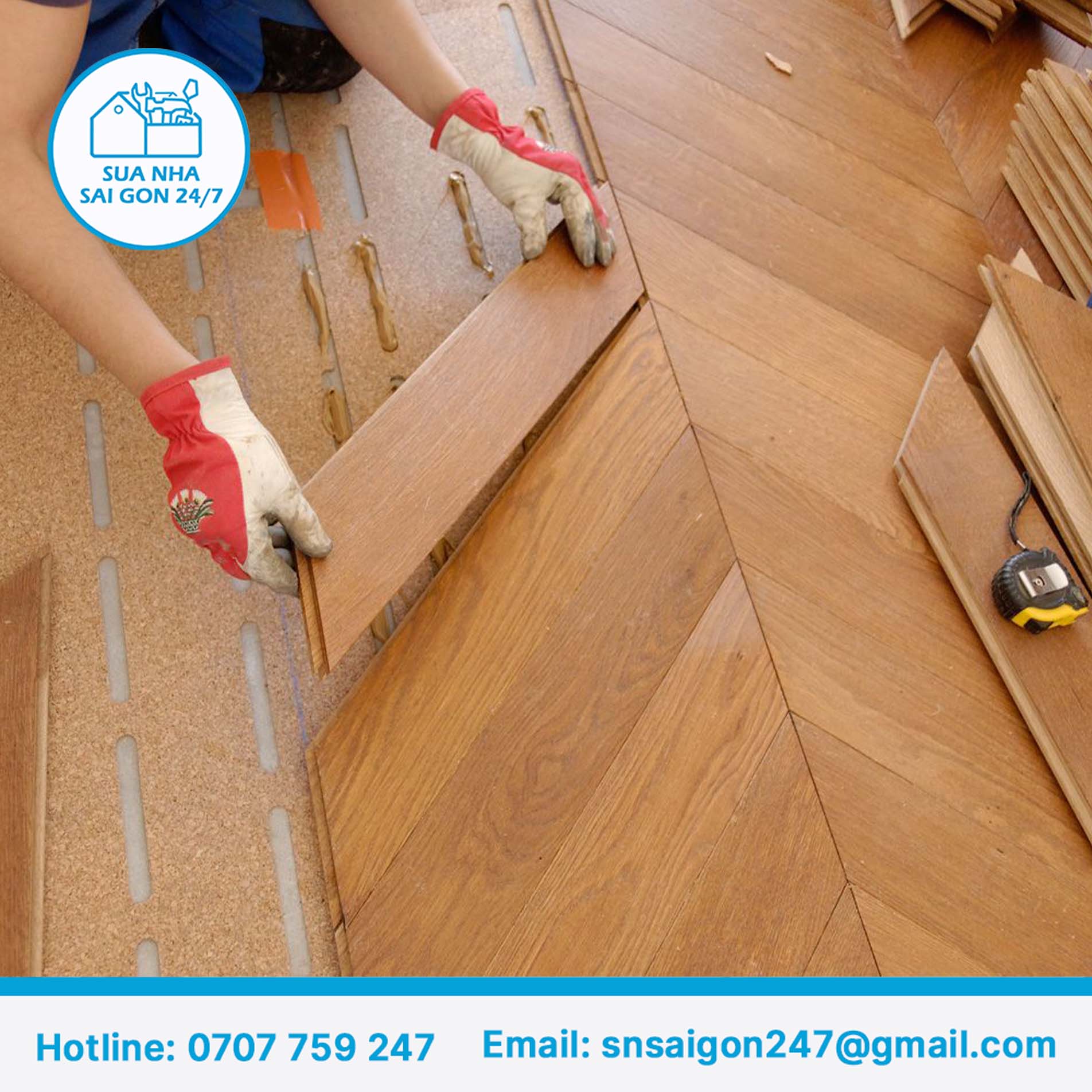
Common Mistakes When Replacing Wood Flooring
Many apartments end up with flooring that fails quickly again because of mistakes made during preparation. Common mistakes include:
- No expansion gap left: the floor swells with humidity and buckles upward.
- Skipping subfloor leveling: an uneven subfloor causes creaking and premature failure of the locking joints.
- Not checking subfloor moisture: a damp subfloor causes the new floor to bulge within a few months.
- Missing underlayment: the floor is noisier, less comfortable underfoot, and wears out faster.
- Loose locking joints: gaps widen over time and boards shift as you walk on them.
This is why subfloor preparation and proper locking technique matter just as much as the quality of the boards themselves. Getting it right from the start means the new floor lasts its full lifespan, without needing early repairs.
Why Choose Sai Gon Home Repair 247?
Whether a new floor looks good depends on installation skill; whether it lasts depends on subfloor preparation and expansion gaps. A provider that controls both will minimize warping and gaps down the line.
Sai Gon Home Repair 247 has over 7 years of experience in repair and interior finishing work in Ho Chi Minh City. We inspect the site first, provide a transparent, itemized quote, install to correct technical standards, and offer a warranty by service item — you work with a single point of contact from survey to handover. For international customers, our team offers support via Zalo, WeChat, and KakaoTalk.
Over 7 years working in Ho Chi Minh City has made the team familiar with the specifics of apartment-building work: humid climate, working around residents still living on-site, and each building’s individual rules. This experience shows in how we assess the subfloor, choose the right flooring type, and handle expansion gaps correctly, rather than applying one approach to every job.
See more on our professional wood flooring installation service in HCMC.
Our Service Commitments
A trustworthy flooring replacement service is defined as much by what happens after handover. Sai Gon Home Repair 247 works to these commitments:
- Free survey & consultation: inspect the subfloor and recommend the right flooring type and approach before quoting.
- Transparent, itemized pricing: removal, materials, and labor broken down clearly, confirmed before work starts.
- Correct technical installation: proper subfloor prep, expansion gaps, firm locking joints, and full clean-up afterward.
- Warranty by service item: support for warping, gaps, or joint failures caused by workmanship within the warranty period.
- Multi-channel support: consultation via hotline, Zalo, WeChat, KakaoTalk for international customers.
These commitments let you plan your budget with confidence and stay assured of quality, instead of worrying about unexpected costs or difficulty reaching us for warranty support.
Service Areas
Sai Gon Home Repair 247 provides apartment wood floor replacement across Ho Chi Minh City: Districts 1, 3, 4, 5, 6, 7, 8, 10, 11, 12, Binh Thanh, Go Vap, Tan Binh, Tan Phu, Phu Nhuan, Binh Tan, Thu Duc City (former Districts 2, 9, and Thu Duc), and the outlying districts of Nha Be, Hoc Mon, Binh Chanh, Cu Chi, and Can Gio. The team works on occupied apartments, vacant units, rental apartments, and offices within residential buildings.
Frequently Asked Questions
How much does apartment wood floor replacement cost per m²?
2026 market reference pricing: removing old flooring costs around 10,000–15,000 VND/m²; installation labor runs about 25,000–60,000 VND/m² depending on the layout pattern; full-package laminate flooring is around 230,000–450,000 VND/m². The exact figure requires an on-site inspection.
When does apartment wood flooring need replacing?
Replace it when the floor is bulging, warping, has wide gaps, creaks noticeably, or has widespread water damage. If only a few boards are damaged and matching spares are available, a partial replacement can work instead of a full one.
Should I replace individual boards or the whole floor?
For localized damage with matching spare boards available, replacing individual boards saves money. When damage is widespread, warping is significant, or you want a different type or color, a full replacement gives a more even, durable result.
Do I need to notify building management to replace flooring?
Usually no formal permission is needed if the work doesn’t affect the structure, but you almost always need to register the work schedule with building management and follow approved hours, since removal and board cutting generate noise.
Can flooring be replaced while I’m still living in the apartment?
Yes. It’s best done room by room, with furniture moved and covered, and work carried out within approved hours. For occupied apartments, the crew needs to cover surfaces, vacuum, and clean up daily.
Which flooring type should I choose when replacing?
Most apartments use moisture-resistant green-core laminate flooring; humidity-prone areas like kitchens or balcony-adjacent rooms should use water-resistant SPC/wood-look vinyl; premium spaces may use solid wood. Choose based on each room’s needs and budget.
How long does apartment floor replacement take?
A 50–70m² apartment typically takes 1–2 days for removal and installation if the subfloor is in good condition. It takes longer if the subfloor needs leveling or if many door bottoms need trimming.
How does apartment wood floor replacement work in Ho Chi Minh City?
It involves inspecting the subfloor, registering the schedule with building management, removing the old flooring, preparing the subfloor, and installing the new floor with correct expansion gaps. Sai Gon Home Repair 247 surveys each apartment and recommends the right flooring type in Ho Chi Minh City.
Sai Gon Home Repair 247 — home repair & interior finishing in Ho Chi Minh City, 7+ years of experience.
English support: +84 33 939 0325 · English & Korean support: +84 76 806 7114
Zalo/WeChat/KakaoTalk available · Email: snsaigon247@gmail.com
Address: 150 Tran Nao Street, An Khanh Ward, Ho Chi Minh City · Hours: Mon–Sat, 08:00–17:30



